Showing posts with label César Viveros Herrera. Show all posts

Friday, May 10, 2013

The Artist in the cycle of Claiming Places


In the book Diálogos, Placemaking in Latino Communities, the writers discuss one definition of place as referring to “territorialized local communities, collective memories associated with territory, claims of authenticity by local actors, phenomenological associations with locales, and social relationships among people in territorial communities.” In other words, place connotes a community’s shared history and experience 


Taller Puertorriqueño’s (Taller’s) proposed move into new facilities, expanding its services to further its mission as an institution that promotes the understanding of Puerto Rican and Latino cultures, was the genesis for its 2012 - 13 exhibition cycle, Claiming Places: Unity, Ownership, and “Hogar” (Home). In the Puerto Rican barrios around Taller, the availability of affordable housing and workspaces is luring in artists, young professionals, and first-time homebuyers who are not Latino. Also entering the mix are Latinos who are not Puerto Rican. This increase in demand and diversity in the area (while not alleviating the needs of the Puerto Rican community living here) has set the stage for a full investigation of what it means for Puerto Ricans and the Latino community in general to claim a place as their own. This concern falls within the context of the Puerto Rican neighborhoods of North Philadelphia, Mexican immigration, changing attitudes of the local youth, and acknowledgment of varying aspirations and viewpoints within the Latino community. This conglomeration, paired with the need and demand for better public services, employment opportunities and understanding, set this cycle in motion.

In constructing this cycle, we started with the premise that the affirmation of one’s Latino ethnic heritage is a political statement and a form of placemaking. Consider for a moment the controversy surrounding Latino studies programs[1] in some quarters of the country, the underfunding of bilingual education[2], and the inability of politicians to find common ground on immigration reform (despite a growing national consensus that this must be addressed[3]), and you may begin to understand that Latinos who may not be political may, nonetheless, feel politicized by their very presence or absence. In this light, any action taken by Latinos in America to assert themselves and their heritage can be construed as placemaking, and artists, whose work may seem far removed from these discussions, are nevertheless drawn in.

Pressures on the Latino community are also displayed as public funding for social services for the neediest is being cut and replaced by neo-liberal models that call for privatization and the marketing of culture[4]. This act of essentially selling cultural experiences whitewashes any cultural distinctions by applying Universalist calls for Latindad without acknowledging national distinctions.[5] To respond to these current issues, we felt it necessary to cast a wide net for this cycle to show the Latino community’s different viewpoints, reflecting that which we have now: the immigrant, the contemporary, the next generation, and the transnational. This produced an unconventional exhibition cycle that was challenging to some artists who were asked to move away from their comfort zones and consider what they feel is their community and how they fit in spatially and socially.

The eight selected exhibitions for Claiming Places: Unity, Ownership, and “Hogar” (Home) come from a variety of communities and disciplines. These exhibitions highlight the distinct ways Latino artists are seeing their worlds and claiming places within their communities. Within this cycle, we exhibit works from artists and groups who were invited to reflect on the concept of claiming places. The exhibitions include:


• César Viveros Herrera, No Me Conformo [I don’t Conform nor Accept], 9/28 - 11/10/2012, born in Mexico, muralist and traditional Aztec and Mayan Performer; (Lorenzo Homar Gallery)

• Ahdanah (Leticia Roa Nixon), Ahdanah (Leticia Roa Nixon), 9/28 - 12/1/2012,, born in Mexico, photo journalist and author; (El Vestíbulo Exhibition Space)

• Merián Soto, Triangulations: Revisiting OYWPP, 12/7 - 1/19/2013,, from Puerto Rico, a choreographer and dancer; (Lorenzo Homar Gallery)

• Youth Artist Program (YAP), Dreams & Realities, 1/25 - 3/23/2013, Philadelphia student artists from Taller’s ; (El Vestíbulo Exhibition Space)

• Esperanza Cortés, Entre Sombras - Sites of Memory, 2/8 - 3/30/2013,, born in Colombia, installation artist and painter; (Lorenzo Homar Gallery)

• Ariel Vazquez, born in Dominican Republic, an urban planner, and the Counter Narrative Society’s (CNS), from Chile and San Francisco, CP LAB, 3/30 - 7/19/2013, an artistic-research-activist unit; (El Vestíbulo Exhibition Space)

• Dino Vazquez, Futuro Metálico, 4/19 - 5/25/2013, born in Puerto Rico, artist and vernacular architect; (Lorenzo Homar Gallery)

• Tony Rocco and the children from North Philadelphia and La Florida, Colombia, Photography Without Borders, 6/14 - 7/20/2013, photography exhibition. (Lorenzo Homar Gallery)


In the next few weeks in four parts we will be reviewing the exhibitions so far while putting the cycle into context. Please join us in this conversation of claiming places and understanding unity, ownership and hogar.

[1] “Rift in Arizona as Latino Class Is Found Illegal” - NYT 1/7/2011

[2] “Suburban Chicago Schools Lag as Bilingual Needs Grow” - NYT 2/9/2012

[3] “POLL AFTER POLL: AMERICAN PUBLIC WANTS IMMIGRATION REFORM WITH CITIZENSHIP,” Americas Voice Online, 1/23/13, An aggregate of polling data :http://goo.gl/34R8P

[4] Arlene Davila, Barrio Dreams, 2004
[5] Arlene Davila, Barrio Dreams, 2004 & Balch Institute for Ethnic Studies of the Historical Society of Philadelphia, Latino Philadelphia:Our Journeys, Our Communities, 2004


Thursday, January 24, 2013

What Unites and Defines a Community Discussion

Poster for Claiming Places Event

Opening Panel Discussion:
What Unites and Defines a Community  

3 PM, Saturday, January 26, 2013

The first of two panel discussions as part of Taller Puertorriqueño's Claiming Places: Unity, Ownership, and “Hogar” (Home) exhibition cycle.  Through art, dance, and architecture, staged in a variety of Taller’s spaces (its gallery walls, its garden, and a neighborhood parking lot - the physical site of Taller’s new facility), this year’s theme seeks to reveal, question, and engage the community in a dialogue  exploring  “ownership” and the consequences of making a space your own. 

Join panelists: artists Merián Soto and César Viveros Herrera; Taller’s Executive Director, Carmen Febo San Miguel; artist and teacher at Taller's education program, Caitlin Peck;  and architect J.C. Calderon, as moderator, and become part of this thought - provoking conversation.

An essay on placemaking and Taller's role in claiming places is here

Eventbrite - Opening Panel Discussion:
What Unites and Defines a Community    (Tickets are FREE)

Sunday, November 11, 2012

Video Interview with Cesar Viveros on his show


César Viveros Herrera from Taller Puertorriqueño on Vimeo.

Here is an interview conducted with Viveros before the opening of his show, No Me Conformo, at Taller Puertorriqueño.  He discusses the reasoning behind the name of his show and what it takes for him, as an immigrant, to be fully integrated into America society. 

Saturday, November 10, 2012

Monarca and the Communal Mural Wall

IMG_3783
Monarca kids at work on the mural
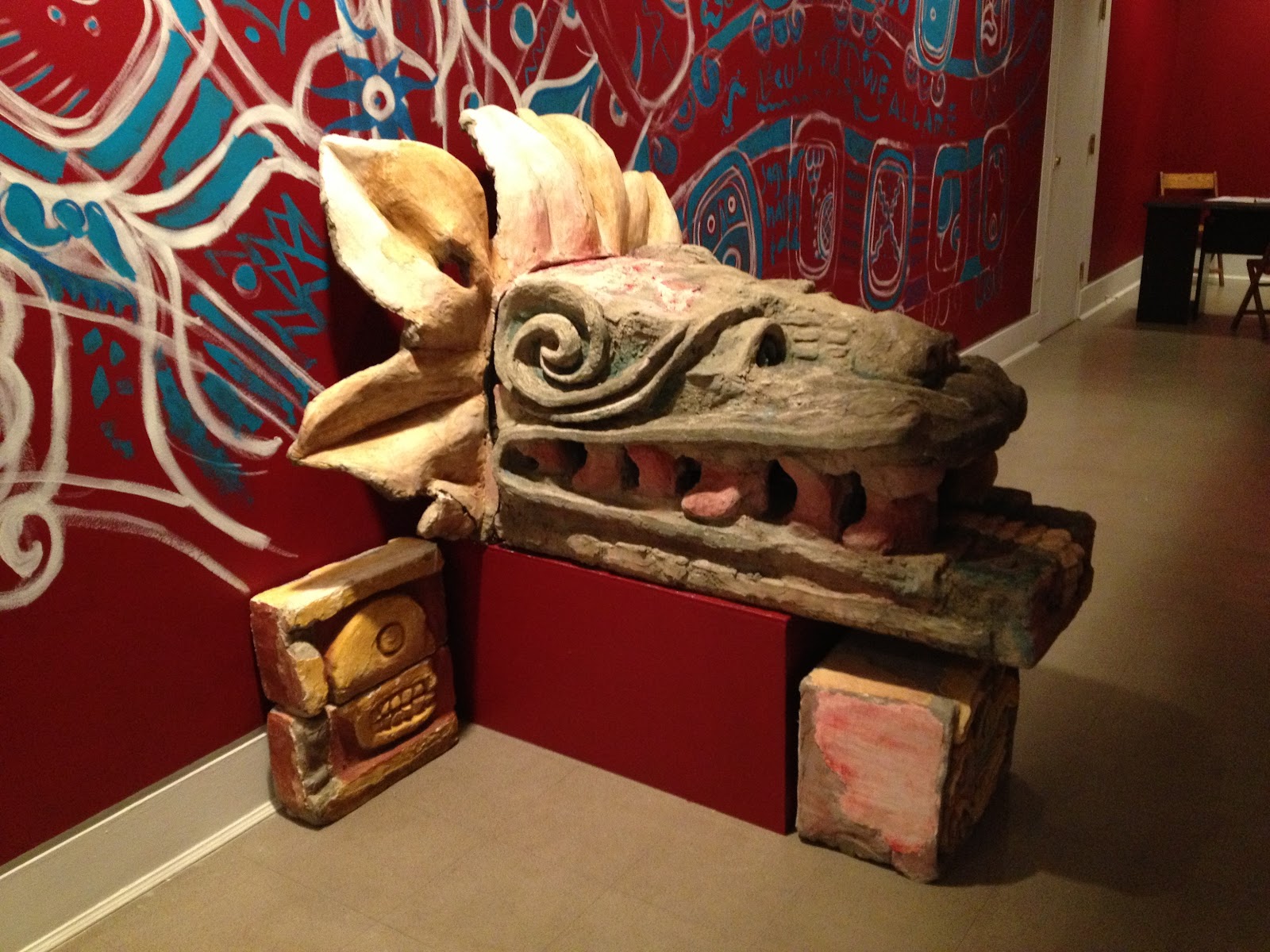
Friday, November 9th, the kids of Casa Monarca came to Taller to see the exhibitions and work on Viveros's communal mural wall.   Viveros started the mural in white with a necklace made out of the symbols of the months taken from the Mayan calendar sprouting from the back of his stone Kulkan's head.

IMG_3793
Detail of child at work

The kids enjoyed working on the mural and learning about Mayan and Aztec history.


IMG_3796
The kids enjoyed painting on the wall
The exhibition ends on November 10th.

IMG_3816
Group Shot

IMG_3818
The finished wall.

Friday, November 9, 2012

Visit from Memories in the Making to No Me Conformo

This morning Dora Viacava and Alicia Mino brought a group from Memories in the Making (Memories) to work on the communal mural that is part of César Viveros' No Me Conformo exhibition.  Memories is a program of Taller's that brings each week specially trained artist to work with the elderly who have been afflicted with memory loss or dementia to work on art.   The art making for the elderly  helps to ground them and maintain connection to their surroundings.

P1120278
Memories in the Making
Bringing them together to work on Viveros's communal wall was a blending of experiences.  Viveros's exhibition is a Teocalli,  a temple or God house where all who come can contribute.

P1120272
A member of Memories points the section she worked on
Created from Viveros memories, our impressions through touch, all the work can be handled by the public, by participating in either the Day of the Dead altar or on the mural, be left.  Direct interactions become a dialogue with what he begun.  The people become in active in the experience.  Their thoughts, their feelings in that moment of painting on the wall gets recorded in the work.


No Me Conformo for Viveros is a statement of not giving up what make him who he is. For this group of citizens, it something that they are familiar with.

Monday, November 5, 2012

Taller's Day of the Dead Celebration


Day of the Dead Altar.
The back drop is skull rack, his Tzompantli that he created in 2008
On Friday, November 2nd, at 5:30PM  Cesar Viveros as part his exhibition, No Me Conformo, brought the Mexican national holiday and tradition, the celebration of the Day of the Dead to Taller Puertorriqueño.  The celebration of the holiday falls on November 1 and 2nd, which coincides with the Christian Holidays, All Saints Day and All Souls Day.  This is example of syncretism of distinct traditions.

Viveros preparing his altar
“The belief is that for two days, there is a path to the other world that allows the souls to return and taste some of the things they used to enjoy,” Viveros said.

Taller's Executive Director, Carmen Febo San Miguel in front of the altar
In his exhibition, Viveros shares a private custom with the public.  This is in continuation with his theme of his exhibition,  of creating contexts where the audience conforms to his expectations and views as a Mexican immigrant. In this case it the following of the celebration of the Day of the Dead.  A tradition the predated the European colonization of the Americas.


Day of the Dead in Mexico is a family event, that is celebrated with altars and visits to the tombs of love ones.  It is comprised of sugar skulls, portraits of the loved ones, momentos, candys and foods as ofrendas (offerings).  The colors are usually festive, and death is made fun of.  Viveros has described this day not only as a time to remember your loved ones but also as a celebration of life.


The altar will be up until the end of the exhibition on November 10th.

Friday, October 26, 2012

César Viveros Herrera: No Me Conformo

Poster - No Me Conformo
Poster for No Me Conformo

September 28th to November 10th, 2012
Lorenzo Homar Gallery

West wing view of the gallery

For this exhibition, César Viveros Herrera asked for the Lorenzo Homar Gallery to be painted a deep red so he could recreate a temple or “teocalli” of out of the memories of his youth. Born in Tejería, Veracruz, Viveros, working from the recollections of his childhood where he would come across ancient artifacts from past civilizations in his father’s cornfields, recreates precious iconographic pieces to construct an ancient place that is still alive and real. It is a world populated with relics of Coatlicue, the Aztec Mother God, to Kukulkan, the feathered serpent, and ancient ruins. To many of the people of his town, these relics did not seem valuable, but to him, the artifacts awoke an intense interest in learning about pre-Columbian civilization and his personal connections to them. Viveros perceives that connection with civilizations from the Olmecs to the Mayans, the Aztecs and Mexico, and with him here, a connection to Philadelphia. 

Kukulkan

As a muralist, Viveros applies his keen sense for seeing these connections to each community he makes a mural for. He is able to listen to the people, opening himself to them so to comprehend their needs and desires. In this show, he is listening to his own voices, his present context, and his cultural and ancestral influences. Over the coming weeks, he will use the walls of the gallery to create a personal mural. On November 2nd, he will conduct a ceremony for the Day of Dead. During the reception, guests can go to a computer station, provide their name, and, by using the Mayan calendar, decipher their Mayan name. 
Reception for No Me Conformo.  Participants working on the mural. 
César Viveros Herrera has been painting murals in Philadelphia for the past 10 years in a wide range of communities. His photorealistic murals offer fantastical collages, often covering entire sides of buildings to create a reflective sense of place for the particular community it depicts and with whom he deeply engages. One of his murals is New Fire (Fuego Nuevo), on Girard near 3rd street, and Cops and Kids at S. 20th St. and Point Breeze Ave. He is also the president of the Mexican Cultural Center.

Other post on Viveros is here.

Interview with Viveros is here.